Apostille vs. Embassy Legalization: What Is the Difference?
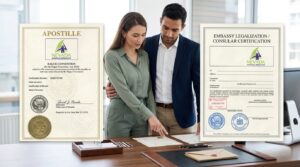 When preparing documents for international use, one of the most confusing topics is the difference between apostille vs embassy legalization. Many people assume both processes are the same, but they are actually two different systems used depending on the destination country.
Understanding whether you need an apostille or embassy legalization is essential for avoiding delays in immigration, spouse visas, overseas employment, international adoption, or legal procedures abroad.
This guide explains the meaning of apostille, embassy legalization, how each process works, and how to know which one you need.
Are Apostille and Legalisation the Same Thing?
No, apostille and legalization are not the same thing.
They both serve the same purpose—verifying that a document is authentic—but they are used in different situations:
- Apostille → used for countries that are part of the Hague Apostille Convention
- Embassy legalization → used for countries that are NOT part of the Hague Convention
So while both confirm document authenticity, the process and authorities involved are different.
If you are dealing with marriage documents, you may also need to understand what is a marriage certificate apostille for proper context.
What Is the Purpose of an Apostille?
The purpose of an apostille is to certify that a public document is genuine and can be legally accepted in another country.
An apostille verifies:
- the signature on the document
- the authority of the issuing official
- and the seal of the issuing office
It removes the need for additional embassy or consulate verification (for Hague countries), making international document use faster and simpler.
Common documents that require apostille include:
- marriage certificates
- birth certificates
- court documents
- diplomas
- notarized documents
For example, if you are moving abroad, your marriage certificate may need authentication before being accepted for visas or immigration processing.
What Is the Meaning of Apostille in Nevada?
In Nevada, an apostille is issued by the Nevada Secretary of State to authenticate state-issued documents for international use.
The meaning of apostille in Nevada is the same as anywhere in the U.S.:
it confirms that a document issued or notarized in Nevada is legally valid for use in other Hague Convention countries.
Nevada apostilles are commonly used for:
- marriage certificates
- business documents
- notarized affidavits
- educational records
If you are applying locally, you may also search for how to apostille a marriage certificate in Nevada for step-by-step instructions.
How Do I Legalize My Documents?
The process of document legalization depends on the destination country.
If the country accepts apostille (Hague Convention):
You only need:
- Certified document
- State or federal apostille
If the country requires embassy legalization (non-Hague countries):
 You must go through multiple steps:
- Get certified document
- State or federal authentication
- U.S. Department of State certification
- Embassy or consulate legalization
This process is more complex and time-consuming than apostille certification.
Understanding marriage certificate apostille vs embassy legalization helps determine which process applies to your case.
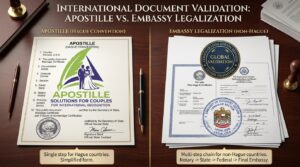
Apostille vs Embassy Legalization (Key Differences)
Here is a simple comparison:
Apostille
- Used for Hague Convention countries
- Issued by Secretary of State or federal authority
- Single-step authentication
- Faster processing
- No embassy involvement
Embassy Legalization
- Used for non-Hague countries
- Requires embassy or consulate approval
- Multi-step verification process
- Longer processing time
- More documentation required
When Do You Need Apostille Instead of Legalization?
You need an apostille if:
- your destination country is part of the Hague Convention
- your document is issued in the U.S.
- no embassy authentication is required
Common use cases:
- spouse visas
- immigration applications
- overseas employment
- international adoption
If you are unsure, checking why employers abroad require marriage certificate apostille can help clarify real-world use cases.
When Do You Need Embassy Legalization?
You need embassy legalization if:
- your destination country is NOT part of the Hague Convention
- the embassy specifically requires authentication
- the country has additional verification rules
This process is commonly required for:
- Middle Eastern countries
- some Asian countries
- certain African nations
In these cases, apostille alone is not enough.
Common Mistakes People Make
Many applicants delay their process because of mistakes like:
- assuming apostille works for all countries
- submitting documents to the wrong authority
- not checking country-specific requirements
- confusing federal vs state authentication
For example, FBI background checks require federal apostille, not Nevada processing.
How Long Does Legalization or Apostille Take?
- Apostille: usually faster (days to weeks depending on state)
- Embassy legalization: longer due to multiple steps (weeks to months)
Processing time depends on:
- document type
- issuing authority
- embassy workload
- submission method
You can compare timelines with how long apostille takes for better planning.
Can a Document Require Both Apostille and Legalization?
No. A document typically requires either apostille OR embassy legalization, not both.
The requirement depends entirely on the destination country’s legal system.
Final Thoughts
 Understanding apostille vs embassy legalization is essential when preparing documents for international use. While both processes verify authenticity, the key difference lies in whether the destination country is part of the Hague Convention.
Choosing the correct process from the beginning helps avoid delays, rejected documents, and unnecessary complications in immigration, employment, or legal procedures abroad.
If you are handling Nevada-issued documents, Nevada Apostille Specialists helps with apostille processing, embassy legalization support, document verification, and international authentication services to ensure your paperwork is accepted globally.
Frequently Asked Questions
Are apostille and legalization the same?
No. Apostille is for Hague countries, while legalization is for non-Hague countries.
What is the purpose of apostille?
To certify that a document is authentic and legally valid for international use.
What is apostille in Nevada?
It is certification issued by the Nevada Secretary of State verifying Nevada documents for international recognition.
How do I legalize my documents?
You must follow either apostille steps (Hague countries) or embassy legalization steps (non-Hague countries).
Which is faster: apostille or legalization?
Apostille is generally faster and simpler than embassy legalization.




Have Any Question?
Get In Touch:
getnotarized@apostillenevada.com